
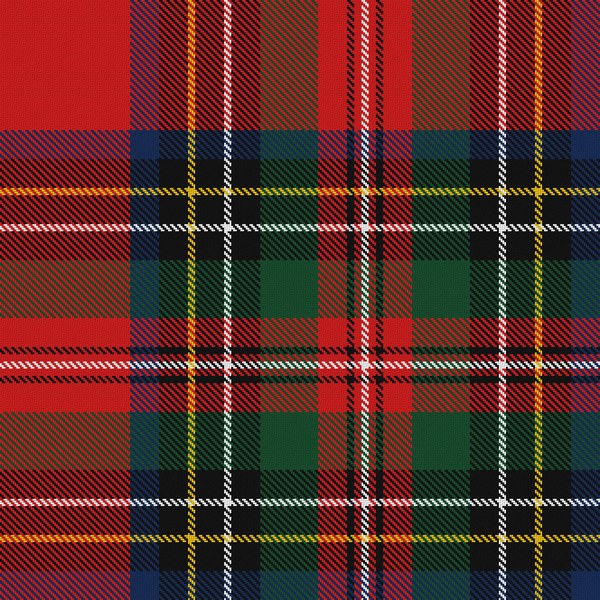
What the historical record says
The Scottish Register of Tartans entry for Stewart, Royal notes that the pattern appears in records of the weaving firm Wilsons of Bannockburn from around 1800, already under the name “Royal Stewart”. The Register says the exact reason for the name is unknown. That documented limit matters: later stories tying the exact sett to the 1745 Jacobite rising are not established by the Register’s record.
The tartan’s royal association and subsequent popularity make it a natural choice for celebrations, festive tables and gifts. Its bright ground also gives it a very different mood from darker choices such as Black Watch.
Is Royal Stewart only for the Royal Family?
Royal Stewart has long been widely worn, but traditions around royal tartans can be stated more carefully than “anyone may wear every tartan”. The Standing Council of Scottish Chiefs says there are no strict rules on who has the right to wear a particular tartan; the Scottish Register also explains that tartans may carry restrictions and that its individual entries should be checked.
The entry for Stewart, Royal shows no restriction in its published record. Check the current Register entry before commissioning or commercially reproducing any tartan, and do not confuse this with the similarly named Balmoral tartan, which has a distinct restricted history.
A bold tartan for gifts and home
Royal Stewart’s high-contrast red makes it a strong focal point in a room or an accessory. It works particularly well when you want a recognisably Scottish look, whether or not you have a Stewart family connection. If you are researching family history, treat the tartan’s popularity as a design choice rather than proof of a genealogical link.
Our planned collection uses high-definition print on smooth fabric. Printed and woven tartan are different textile constructions; read our practical comparison before choosing by material or finish. You can also browse the tartans planned for the collection.